
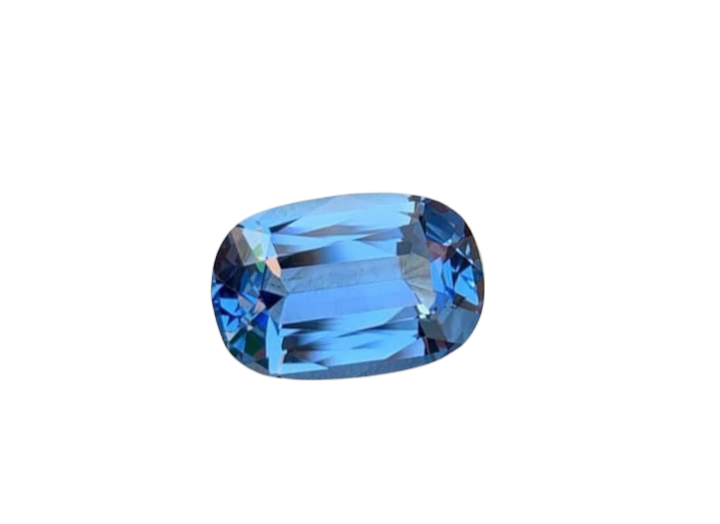
Beryllium-treated:
Gemstones that have undergone high-temperature treatment with the addition of beryllium. The beryllium treatment primarily produces the colors golden yellow, orange, pink, and red, as well as the sought-after Padparaja color.
The penetration depth of the beryllium ions is directly proportional to the treatment time. The longer the treatment, the deeper the color penetration.
Today, the stones are fired until the color penetrates the entire stone, or at least almost the entire stone. Sometimes, a small core of the original color is intentionally left. For example, a remaining pink core in the resulting red creates a particularly vibrant hue.
The Gemmological Institute of America (GIA) and other authoritative institutions in the gemstone industry have agreed to refer to beryllium treatment as diffusion treatment.
Coated, vapor-coated:
Some gemstones, especially topaz and quartz, are artificially colored using various methods, such as physical or chemical vapor deposition.
This involves applying an ultrathin layer of metal, for example, titanium or gold. The colors of stones treated in this way range from pink to red, green, and teal. A rainbow-colored iridescent variety is sold under names such as “Mystic Topaz” and “Aurora Topaz,” among others.
What all these stones have in common is that the color layer is only a few microns thick. Experience shows that the color can be removed very easily. Even normal handling with tweezers can cause scratches that, due to the extremely thin layer, cannot be polished out.
Chalos Gems does not, as a matter of principle, deal in stones treated in this way.
Irradiated:
Some gemstones, but primarily topaz, are irradiated with gamma rays, neutrons, or electrons to create or enhance their color.
The first color that could be produced in topaz through irradiation was London blue, an intense, slightly greenish (petrol) blue.
Todaz, topazes are mainly produced in the colors swiss blue, a very bright light blue, and sky blue, an aquamarine-like blue.
After treatment, the irradiated topase cells must “cool down” for several months to allow any residual radiation to dissipate. The length of this resting period depends on the type of radiation therapy.
To dispel any remaining doubts, we store topazes for at least another three months before releasing them for sale. Most of our topazes have already been stored for many years!
Is wearing irradiated gemstones dangerous?
No! The U.S. Nuclear Regulatory Commission (NRC) states in a report:
The NRC has no indication that wearing irradiated gemstones can be harmful. There have been no reported cases of anyone being harmed by wearing irradiated gemstones.
The NRC has no indication that wearing irradiated gemstones can be harmful. No cases have been reported of anyone being harmed by wearing irradiated gemstones.
Furthermore:
From a safety standpoint, there is no reason to stop wearing blue topaz or any other irradiated gems.
From a safety standpoint, there is no reason not to wear irradiated blue topaz or any other irradiated gemstones.
… And finally:
A study done by the NRC estimated that a person wearing a blue topaz stone at the highest level of radioactivity allowed for distribution under NRC regulations would receive an annual dose of 0.03 millirem (NUREG 1717, page 2-21). By contrast, a chest X-ray is about 60 millirem.
An NRC study estimated that someone wearing an irradiated topaz with the highest level of residual radiation allowed for distribution under NRC safety regulations would receive an annual radiation dose of 0.03 millirem. For comparison, the radiation exposure from a chest X-ray is about 60 millirem.
Diffusion treated:
Diffusion treatment is primarily used on blue sapphires and, much less frequently, on rubies to intensely color very pale or almost colorless stones.
This involves a high-temperature treatment with the addition of coloring elements, such as titanium for blue sapphires and chromium for rubies, which diffuse into the stone from the outside, creating the intense color.
The problem with this treatment method is the shallow penetration depth of the color, averaging only 0.2-0.4 millimeters. This means that the artificially created color is partially or completely removed during polishing or recutting.
At Chalos Gems, we consider this type of gemstone treatment a violation of the ethical principles of the gemstone trade and do not offer such stones.
Identification:
The color of diffusion-treated sapphires and rubies is concentrated at the facet edges, as the coloring elements can penetrate from two sides there.
This phenomenon becomes visible when the stone is embedded in a highly refractive liquid such as methylene iodide (cooking oil will also work in a pinch).
Star rubies and star sapphires, in which both the star pattern and the color are created through diffusion treatment, have also been available on the market for some time.
These stones are characterized by unnaturally sharp stars and a completely homogeneous color distribution.
Glass filled:
The process is recognized by the CIBJO (Confédération Internationale de la Bijouterie, Joaillerie, Orfèvrerie, des Diamantes, Perles et Pierres, or International Jewelry Association). According to the CIBJO, stones that have undergone this type of clarity enhancement must be marked as such.
Currently, the process is primarily used on African rubies.
The problem is that the fillers are very sensitive to acids and solvents. The acid (potassium alum or sulfuric acid) in which the goldsmith places the ring for pickling after resizing, and even lemon juice, is enough to damage the glass filling and completely alter the appearance of the stone.
Heat treated:
Gemstones that have undergone heat treatment for color enhancement.
Heat treatment of gemstones is a legitimate and globally recognized method, also accredited by the CIBJO (Confédération Internationale de la Bijouterie, Joaillerie, Orfèvrerie, des Diamantes, Perles et Pierres – International Confederation of Jewelry, Jewelry and Crafts), which does not require any special distinction, but merely a general recognition.
The art of “heating” gemstones is almost as old as the gemstone trade itself and is first documented by Pliny the Elder (23–79 BC) in his monumental work, Natural History.
In pure heat treatment, no color is introduced into the stone from the outside. Rather, it simply brings out the color that is already potentially present in the stone.
Explanation using blue sapphire as an example:
The color-giving elements (chromophores) in blue sapphire are titanium ions and, to some extent, iron ions (which also produce an undesirable greenish tint).
A very common inclusion mineral in sapphire is rutile, a titanium mineral with the chemical formula TiO₂.
The melting point of titanium is 1656°C, while that of sapphire is 2053°C.
If the sapphire is heated to temperatures above the melting point of the rutile inclusions, titanium ions diffuse from the rutile into the surrounding host crystal, creating/intensifying the desired blue color.
In other words, if Mother Nature had heated the sapphire sufficiently (again) during its formation, exactly the same thing would have happened.
At the same time, the rutile needles dissolve into small grains or even fine dust, thus slightly improving the clarity of the stone.
The colors produced by heat treatment are stable, meaning they do not fade under UV radiation.
The color change affects the entire stone and not, as with diffusion treatment, only a few tenths of a millimeter below the surface.
Stones that have undergone only heat treatment—and not diffusion treatment!—can therefore be easily polished to remove signs of wear or recut to fit a smaller setting.
As long as not too much volume is removed during recutting, the color will not be altered.
According to the CIPJO guidelines, a heat-treated gemstone is commercially available and does not necessarily have to be declared.